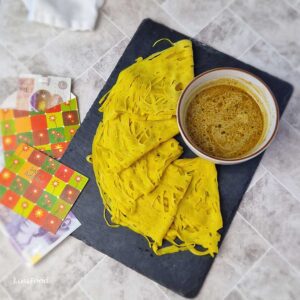
Roti Jala (Lacy Malay Net Pancakes)
Soft, lacy Malay net pancakes made with a thin turmeric batter and traditionally served with curry. Includes vegan and gluten free notes, plus tips for making roti jala with or without a traditional mould.
Ingredients
- 260 g plain flour
- 1 tsp ground turmeric
- ½ tsp fine salt
- 2 large eggs
- 300 ml coconut milk
- 2 tsp neutral oil plus more for lightly greasing the pan
- 400 ml water
Instructions
- In a large bowl, whisk together the flour, turmeric, salt and sugar.260 g plain flour, 1 tsp ground turmeric, ½ tsp fine salt
- Add the eggs, oil and coconut milk, then whisk until smooth.2 large eggs, 300 ml coconut milk, 2 tsp neutral oil
- Gradually whisk in the water. You want a thin, pourable batter, roughly like single cream. If it still feels too thick to flow easily, add more water a little at a time.Don't add all of it at once, as you don't want a batter that's too runny.400 ml water
- Rest the batter for 20 minutes.
- Strain the batter through a sieve into a jug or bowl. This makes a real difference, because even a few stubborn lumps will clog your bottle or cup and ruin the lace effect.
- Pour the batter into your roti jala cup or squeeze bottle.
- Heat a non-stick pan over medium-low heat and lightly oil it with a pastry brush. This should ensure that your pan is only lightly greased, not swimming in oil. So there shouldn't be any need to wipe excess with a kitchen paper as you read on all other food sites.
- Drizzle the batter onto the pan in overlapping circles or a loose criss-cross pattern, covering most of the surface but not piling batter too heavily in one spot.Don't worry too much about getting perfect waves or circles. It's not mean to be pretty, we just want crisscrossed lines, as we'll be rolling or folding it all up.
- Cook for about 45 to 60 seconds, or until the surface is set and the pancake lifts easily. Do not flip. Roti jala is usually cooked on one side only, and overcooking makes it brittle.A great visual cue here is to look out for the edges to just begin to lift ever so slightly. This means that the roti is solid enough to lift but not too crisp that it will break and lose that signature softness.
- Lift it out gently with a spatula or your fingers once cool enough to handle.Fold in the sides and roll it up, or fold into quarters or triangles if that is your preferred style.I fold it in the pan itself, as you can see in the video. If rolling, it's best to transfer to a board to do it.
- Repeat with the remaining batter, giving the pan the lightest swipe of oil as needed.A good roti jala should be soft, thin, pliable and properly lacy. If the first one looks tragic, welcome to the club. The second and third are usually where your hand finds its rhythm.
Nutrition
Serving: 4piecesCalories: 346kcalCarbohydrates: 42gProtein: 9gFat: 16gSaturated Fat: 12gPolyunsaturated Fat: 1gMonounsaturated Fat: 2gTrans Fat: 0.01gCholesterol: 65mgSodium: 274mgPotassium: 216mgFiber: 1gSugar: 1gVitamin A: 95IUVitamin C: 1mgCalcium: 31mgIron: 5mg
Tried this recipe?Mention @azlinbloor or tag #linsfood!
Made it? Upload your Photos!Mention @azlinbloor or tag #linsfood!