

This ikan bakar-inspired salmon traybake gives you sambal-rubbed salmon baked over thin turmeric potatoes with kaffir lime leaves, tamarind, belacan and optional banana leaves. It’s not traditional ikan bakar, because the oven is doing the work here, but the flavour direction is very much there: spicy, aromatic, sharp, savoury and made for eating with cucumber and lime.
Estimated reading time: 12 minutes
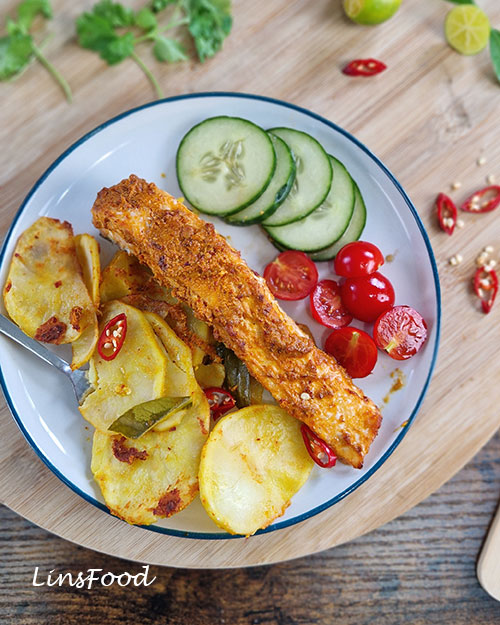
What is Ikan Bakar-Inspired Salmon Traybake?
Ikan bakar means “grilled fish” in Malay and Indonesian.
- Ikan = fish
- bakar = burn, in this case, grilled/barbecued
Proper ikan bakar is usually cooked over charcoal or a hot grill, often with a spicy sambal-style paste, banana leaves and that unmistakable smoky aroma you only get when fire is involved.
This recipe is not that.
This is an oven-friendly salmon traybake inspired by those flavours: dried red chillies, onions, garlic, lemongrass, turmeric, tamarind, belacan, kaffir lime leaves and a little sugar to round everything out. The salmon is rubbed with the sambal paste, then baked over thinly sliced turmeric potatoes so they absorb the chilli oil, fish juices and all the fragrant bits that would otherwise be wasted.
And no, potatoes are not the classic base for ikan bakar. But in a traybake, they make complete sense. They hold their shape, soak up flavour beautifully, and don’t demand the same careful liquid-and-steam management as rice.
Banana leaves are optional, but lovely. They add fragrance, protect the base slightly and make the tray feel closer to the ikan bakar spirit, even if your oven is pretending to be a charcoal grill and we’re all politely going along with it.
Ikan Bakar Flavours, Traybake Method
This traybake uses the flavours I associate with ikan bakar and has three main parts: the sambal paste, the turmeric potatoes and the salmon.
Proper ikan bakar is grilled fish, usually cooked over charcoal or a hot grill, often with a sambal-style paste and banana leaves. Here, the oven takes over, but the key flavours are still doing the work: dried red chillies, shallots, garlic, lemongrass, turmeric, tamarind, belacan, kaffir lime leaves and a little sugar to balance everything.
The potatoes go in first because salmon cooks quickly. They’re sliced thinly, tossed with turmeric, kaffir lime leaves, a little hot water or stock, and a spoonful of the sambal paste, then baked under foil until nearly tender. This gives them time to soften before the fish joins the tray.
Once the potatoes have had their head start, the salmon is placed on top. It bakes uncovered just until cooked, so the sambal catches a little heat and the fish stays moist. The potatoes underneath absorb the chilli oil, turmeric, lime leaf fragrance and salmon juices, which is exactly why they work so well here.
Banana leaves are optional, but they’re worth using if you have them. They add fragrance, help protect the base slightly, and give the traybake more of that ikan bakar feeling without pretending your oven has suddenly become a charcoal grill.
Why Potatoes Instead of Rice?
I did consider rice for this traybake, because fish, sambal and rice are obviously good friends. But for this recipe, potatoes are the better choice.
Salmon cooks quickly, and rice needs time, steam and the right amount of liquid. You can absolutely make a sambal salmon rice bake, but it becomes a more managed recipe: cook the rice first, add the salmon later, check the liquid, cover, uncover, possibly mutter. There is a time and place for that, but this traybake is meant to be easier.
Potatoes are more forgiving. Slice them thinly, give them a covered head start, then add the salmon. They absorb the sambal oil, turmeric, kaffir lime and salmon juices without needing the same precise timing as rice.
They also make this recipe feel different from the chicken-and-rice traybakes in this series. Akan datang! (Coming soon) There’s only so much rice one traybake series can carry!
Ingredients
The ingredients are straightforward, but a few of them do most of the heavy lifting.
Salmon works well here because it’s rich enough to handle the sambal. You can use four fillets or a whole side of salmon. Fillets are easier for testing and serving, while a whole side looks more dramatic if you’re filming or feeding a group.
You can also use any white fish, if you prefer.
Dried red chillies give the sambal paste depth and colour. Soak them in hot water first so they blend properly. Use fewer chillies or remove some seeds if you want a milder paste.
Also – very important – not all chillies are created equal, so get to know your chillies before yo uplan a big feast for guests.
Onion and garlic form the savoury base of the paste.
Lemongrass gives the sambal that citrusy, aromatic backbone. Peel away the tough outer layer, trim the top and root end, then use about 10cm / 4 inches of the bottom part of each stalk.
Read more about lemongrass and how to use it here.
Turmeric adds warmth and colour. It also gives the potatoes that golden edge, which looks excellent against the red sambal.
Belacan (shrimp paste) is optional, but very much recommended if you like the flavour. It adds savoury depth and makes the sambal taste more complete. If you can’t find it, leave it out.
Read more about belacan here.
Tamarind paste brings sourness. This is important with salmon because the fish is naturally rich.
Click here to read all about tamarind and how to use it.
Fish sauce and salt seasons the paste. Fish sauce gives more depth, and salt just rounds it off.
Palm sugar or simple white sugar as substitute balances the chilli, tamarind and salt. You don’t need much.
Kaffir lime leaves add fragrance and a sharp citrus note. Tear them for the potatoes and slice or tear them for the sambal paste. You may see them labelled as makrut lime leaves in some shops. Omit if unavailable and finish with some coriander leaves (cilantro).
Waxy potatoes are my first choice because they hold their shape well. Slice them thinly, about 3-4mm thick, so they cook before the salmon dries out.
Banana leaves are optional. They add fragrance and a little ikan bakar feeling to the tray. They’re not eaten, and they’re not essential, but they do make the whole thing look and smell more convincing.
Click here to read up on how to prepare banana leaves and use them.
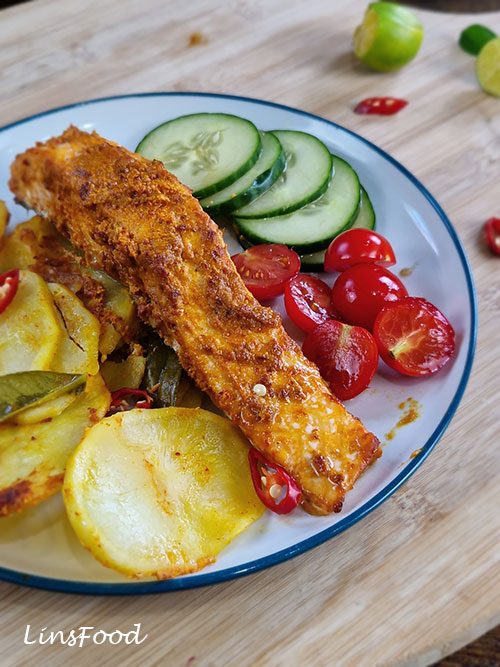
Getting the Potatoes and Salmon Right
The potatoes need a head start. This is the most important part of the recipe.
Salmon cooks fast. Potatoes do not care about your schedule. If you put everything in the tray at once, the fish will be done long before the potatoes are tender. That’s why the potatoes bake first under foil, then the salmon is added later.
Slice the potatoes thinly and evenly, around 3-4mm thick. If the slices are too thick, they’ll take too long. If they’re paper-thin, they may break up. Aim for thin but still sturdy.
Use hot water or stock in the potato layer. It helps the potatoes steam under the foil and prevents the base from drying out too quickly.
The salmon should flake easily but still look moist. If you use a thermometer, aim for about 50-52°C for slightly pink, moist salmon, or closer to 60°C if you prefer it fully cooked through. Bear in mind it will continue to cook a little as it rests.
If the salmon is ready before the potatoes, lift the fish onto a plate, cover it loosely and return the potatoes to the oven for another few minutes. Better that than sacrificing the salmon to potato timing.
How to Use Banana Leaves
Banana leaves are optional, but they’re a beautiful addition.
They add a gentle fragrance and give the traybake a nod towards ikan bakar, where banana leaves are often used to wrap or line fish before grilling. They also look wonderful in photos and videos, which is not the main point, but we’re not above appreciating a good-looking tray.
To use banana leaves, wipe them clean first. Then soften them by briefly passing them over a gas flame, or by pouring boiling water over them. This makes them more flexible and less likely to tear. See this in action on my YouTube channel here.
Pat them dry and line the roasting tin with them, shiny side facing up. Trim any large overhanging edges so they don’t catch in the oven. The leaves may darken and dry at the edges, which is normal, but you don’t want dramatic burnt leaf theatre happening under the grill.
The banana leaves are not eaten. They’re there for fragrance, protection and general good behaviour.
How to Serve
Serve this ikan bakar-inspired salmon traybake with a simple cucumber salad. (salad = kerabu in Malay). Just toss cucumber, red onion, coriander or mint, lime juice, a pinch of salt, a pinch of sugar and a little sliced chilli. It gives the tray a fresh, sharp side without requiring you to cook anything else.
The cucumber gives crunch and freshness, which you really want against the sambal and salmon. The lime sharpens everything at the end. If you have fresh coriander, scatter some over the top. Sliced red chilli looks good too, if you want a little colour and heat.
You can also serve it with plain rice if you want a bigger meal. Yes, I know we’ve already chosen potatoes.
Other good sides include stir-fried greens, blanched pak choi, kangkung, a simple tomato and cucumber salad, or extra sambal if you’re that person.
How to Store Leftovers
Eat this traybake freshly cooked, while the salmon is still moist and the potatoes are tender.
If you have leftovers, cool them quickly and refrigerate within 2 hours. Store in an airtight container in the fridge for up to 2 days.
Reheat gently until hot. Salmon can dry out if reheated aggressively, so use a moderate oven or microwave in short bursts. Add a small splash of water around the potatoes if they look dry.
I don’t recommend freezing this one. Cooked salmon and sliced potatoes can both change texture after thawing, and not in a charming way.
Leftover salmon can be flaked into rice, tucked into wraps, or eaten cold with cucumber and a squeeze of lime. Cold sambal salmon with rice is not a hardship. Really not.
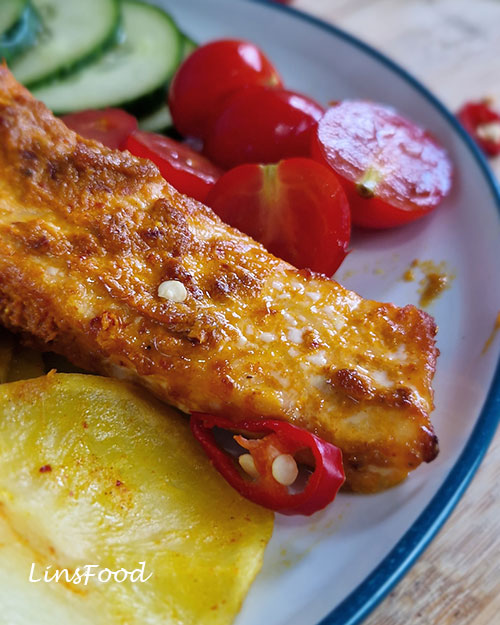
Variations
You can use a whole side of salmon instead of fillets. It looks impressive and works well if the piece is fairly even in thickness.
You can use sweet potatoes, but I wouldn’t make them my first choice. They’ll soften faster and make the tray sweeter, which may push the balance away from the sambal. If using them, slice them a little thicker and watch the timing.
You can add sliced red peppers to the potato layer if you want more colour, but don’t overload the tray. Too many vegetables will release moisture and affect how the potatoes cook.
You can also use white fish, or even seafood.
You can easily make this vegetarian or vegan: leave out the belacan and top the potatoes with tofu, vegan pieces or oven-friendly vegetables such as aubergines, courgettes and carrots.
FAQs
No. Traditional ikan bakar is grilled fish, often cooked over charcoal or on a hot grill. This is an oven traybake inspired by ikan bakar flavours, using sambal, kaffir lime leaves, lemongrass, turmeric, tamarind, belacan and banana leaves.
Ikan bakar means “grilled fish” in Malay and Indonesian. Ikan means fish, and bakar means grilled or burned.
Salmon is not the most traditional fish for ikan bakar, but it works very well in this traybake because it’s rich enough to stand up to the sambal paste. The recipe is inspired by ikan bakar rather than claiming to be the classic version.
Use dried red chillies for a deeper sambal flavour and colour. Fresh chillies alone will give a brighter, lighter paste. A mix of mostly dried chillies with one fresh chilli works beautifully.
No, belacan is optional, but it adds a lot of savoury depth. If you like the flavour and have it, use it. Toast it first before adding it to the paste.
Yes. Banana leaves add fragrance and a more ikan bakar-style feel, but the recipe works without them. Just place the potatoes directly in the roasting tin.
Charlotte potatoes are my first choice because they hold their shape and cook nicely when sliced thinly. Maris Piper, Yukon Gold, baby potatoes or other waxy/all-rounder potatoes can also work.
Yes, but the method changes. Rice takes more liquid and needs to cook covered before you add the salmon. Potatoes are easier and more forgiving here: start cooking them first, then add the salmon later.
Slice the potatoes about 3-4mm thick. This helps them cook through before the salmon dries out.
Yes. A whole side of salmon works well, especially for filming or serving guests. Choose one that’s fairly even in thickness so it cooks evenly.
Add the salmon only after the potatoes have had a head start. Bake the salmon just until it flakes easily and still looks moist. If the potatoes need longer, remove the salmon and let the potatoes finish cooking on their own.
Yes. You can make the sambal paste a day ahead and keep it covered in the fridge. Bring it closer to room temperature before rubbing it over the salmon.
Final Word
And there you go. Ikan bakar-inspired salmon traybake with sambal, kaffir lime leaves and turmeric potatoes.
It’s not traditional ikan bakar, and it’s not trying to sneak into the barbecue wearing sunglasses. But it does take the flavours seriously: dried chillies, lemongrass, turmeric, belacan, tamarind, kaffir lime leaves, banana leaves if you have them, and that lovely balance of heat, salt, sourness and fragrance.
Make it and let me know what you think!
Lin xx
Ikan Bakar-Inspired Salmon Traybake with Potatoes
Equipment
- deep roasting tin or baking dish, about 23 x 33cm / 9 x 13 inches.
- Foil
- Oven
Ingredients
For the sambal paste
- 10 dried red chillies
- 1 medium onion
- 4 medium garlic cloves
- 2 lemongrass stalks
- 1 tsp ground turmeric
- 1 tsp toasted belacan leave out, if unavailable
- 2 Tbsp fish sauce
- ½ tsp salt
- 1 tsp palm sugar or white sugar
- 2 Tbsp neutral oil
- 4 kaffir lime leaves
Tamarind (skip if using shop bought paste)
- 1 heaped Tbsp tamarind pulp
- 60 ml hot water
For the potatoes
- 700 g waxy potatoes (or all rounders)
- 1 Tbsp neutral oil
- ½ tsp ground turmeric
- ½ tsp fine sea salt
- 100 ml hot water or light stock
- 4 kaffir lime leaves
For the salmon
- 4 salmon fillets about 150–180g each
- 1 2 banana leaves completely optional
To finish and serve
- Juice of ½ lime
- Fresh coriander optional
- Sliced red chilli optional
Instructions
Prep work
- Preheat the oven to 200°C / 180°C fan / 400°F.Use a deep roasting tin or baking dish, about 23 x 33cm / 9 x 13 inches.
- Red chillies. Roughly cut or break the dried red chillies into 2-3 pieces straight into a bowl and cover them with hot water. Soak for 15 minutes, then drain well. For less heat, shake out some of the seeds after soaking.10 dried red chillies
- Tamarind. Soak the tamarind pulp in the hot water for 15 minutes.At the end of the 15 minutes, mash it up with your hands and scoop out the seeds and any string or grit.Only use a sieve if you have a fairly large mesh sieve. Straining your tamarind will mean you don't get all the pulpy essence.1 heaped Tbsp tamarind pulp, 60 ml hot water
- Peel and roughly chop the onion.Peel the garlic cloves.Peel away the tough outer layer of the lemongrass, then trim off the root end and the dry top. Use about 10 cm (4 in) of the bottom part of each stalk. Slice into rings.1 medium onion, 4 medium garlic cloves, 2 lemongrass stalks
- Toast the belacan. You can do this in a dry pan for a couple of minutes, or wrap it in foil and toast it briefly, until fragrant. Let it cool slightly before adding it to the paste.
- Measure out the tamarind paste (if nor using pulp), fish sauce, salt, sugar, oil and turmeric.
- Tear all the kaffir lime leaves and set aside.4 kaffir lime leaves, 4 kaffir lime leaves
- Potatoes. Scrub or peel the potatoes, as you prefer. Slice them thinly, about 3–4mm thick. Try to keep the slices fairly even so they cook at the same rate.700 g waxy potatoes (or all rounders)
- If using banana leaves, wipe them clean. Soften them by briefly passing them over a gas flame, or by pouring boiling water over them. Pat dry, then use them to line the roasting tin, shiny side facing up. Trim any large overhanging edges so they don’t catch in the oven.You may see in the video that I didn't bother softening the banana leaves. They were from my garden, very young and small, and pretty soft.1 2 banana leaves
- Chop or pick any fresh herbs you’re using. And slice the red chillies.Fresh coriander, Sliced red chilli
Make the sambal paste
- Place the soaked and drained dried chillies in a food chopper.10 dried red chillies
- Add the onion, garlic, lemongrass, turmeric, toasted belacan, tamarind paste, fish sauce or salt, sugar and oil.1 tsp ground turmeric, 1 tsp toasted belacan, 2 Tbsp fish sauce, ½ tsp salt, 1 tsp palm sugar , 2 Tbsp neutral oil, 1 heaped Tbsp tamarind pulp
- Blitz to a semi smooth paste. It doesn’t need to be completely smooth.In the video, you'll see that mine is pretty smooth, that's because of the food processor I have and its blades! But you don't have to worry about yours being too smooth.
- Taste the paste. It should be spicy, salty, sharp and lightly rounded. If it tastes slightly harsh while raw, that’s normal. If it tastes quite bitter, add a little more sugar, tamarind and oil to balance it.
- Take 2 Tbsp of the sambal paste out for the potatoes.Rub the salmon with the remaining sambal paste.4 salmon fillets
Let's get cooking – the potatoes
- Place the sliced potatoes in the roasting tin, on top of the banana leaves if using.
- Add the neutral oil, turmeric, salt, hot water or stock, torn kaffir lime leaves and about 2 Tbsp of the sambal paste.I stirred the sambal paste into the water.1 Tbsp neutral oil, ½ tsp ground turmeric, ½ tsp fine sea salt, 100 ml hot water or light stock, 4 kaffir lime leaves
- Toss everything together so the potatoes are lightly coated.
- Spread the potatoes out as evenly as possible. They don’t need to be in a perfect single layer, but avoid thick piles.
- Cover the tray tightly with foil.
- Bake for 30 minutes, until the potatoes are nearly tender. The timing will depend on how thinly the potatoes are sliced and how much they overlap.A small knife should run through pretty easily, with just the slightest resistance.
- Salmon. Remove the tray from the oven and carefully take off the foil. Watch out for the steam.
- Place the salmon on top of the potatoes, skin-side down if using fillets with skin.
- Return the tray to the oven, uncovered.Bake for15 minutes. 20, if you like your salmon well done.The salmon should be just cooked through and still moist.
Finish and serve
- Squeeze the lime juice over the salmon.Juice of ½ lime
- Scatter with coriander and sliced red chilli, if using.Serve with a simple side salad.