

Enjoyed this recipe? Add us to your Google Search Preferred Sources:
Laksa leaves are one of my favourite herbs. With a sharp, slightly spicy fragrance with lemony and tangy flavours, it is a must when cooking laksa.
Estimated reading time: 7 minutes

What’s in Name?
In Singapore, Malaysia and Indonesia, we call them daun kesum or laksa leaves. Daun is the Malay word for leaf and kesum is the name of this herb.
Persicaria Odorata is an indispensable herb throughout South East Asia, from the very top of the region, right down to the ends of Indonesia. Commonly called laksa leaves, daun kesum are also known as:
- Vietnamese Coriander
- Vietnamese Mint
- Rau Ram in Vietnam
- Phak Phai in Thailand
And so much more! I cannot live without it. Along with the Indian curry leaf, Kaffir lime leaves and galangal, laksa leaves were one of the first things I sourced out when I moved to the UK in the 90s.
How to use Laksa Leaves?
Rather obviously, we use Vietnamese mint when making laksa. It gives an indefinable aroma that is one of the identifying features of Singaporean and Malaysian laksa.
In fact, many, many Singaporeans and Malaysians will tell you that if you are not using laksa leaves then you haven’t got laksa. All you have is a bowl of curried noodles! Like Beef Rendang without turmeric leaves, as I mention on that post.
Vietnamese Coriander is used in so many other ways too. We use it in soups, curries, stir-fries and salads. The iconic Lao salad, larb, or laab, is made with daun kesum.
And here are 2 recipes on SMR that use Laksa Leaves:


How to Grow Laksa Leaves (Vietnamese Mint)?
Is it easy to grow Vietnamese Mint? Yes, so, so easy! All you need is access to some fresh leaves (as long as they’re not frozen). It’s extremely easy to propagate but if you don’t live in the tropics, you have to be careful with very low temperatures. It’s not fond of overly cold winters, but is quite happy outdoors in milder ones. Days of snow is probably not ideal.
This is what you need to do to grow your own daun kesum:
- Snip 2-3 stems off a plant. Always grow extra.
- Place in water until they sprout roots.
- Pot them up.
Full instructions are at the end of this article.

How to look after Daun Kesum Plant?
As mentioned above, temperature plays a big part in how happy your plant is going to be. Unless you have snow for prolonged periods, you should be able to grow your daun kesum outdoors, in the ground.
It might need a little TLC from time to time, especially after a cold spell and when the temperatures start to warm up again in spring.

The Vietnamese Mint has a voracious appetite. You need to feed it regularly with an all-purpose plant food or a seaweed feed, although the latter is more of a nourisher than a feed. At the slightest sign of yellowing or coppery leaves, be sure to feed your plant.
Daun kesum needs plenty of light but not too much direct sunlight. In fact, my plants that are grown in mostly shade are the ones that have always performed best.
Laksa leaves also love water but you don’t want the compost to be too wet when planting in a pot. Allow the surface to be dry looking before you water it. Of course, if grown in the ground, you are at the mercy of the elements.
Use the leaves regularly to maintain a compact, bushy growth. If left to its own devices, it has a creeping habit.
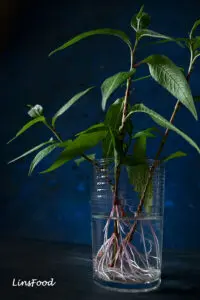
One interesting thing about growing your Vietnamese mint indoors and out is the colour of the leaves. When grown outdoors, as they should be, the leaves have a darker shade in the middle and near the base, as you can see in the image below of one of my daun kesum plants. The indoor plants, in my experience of growing laksa leaves in the UK (almost 30 years!) lose this shade and become a uniform green in colour (the glass image).

Where to Buy Them?
Unlike calamansi limes, which are sold at miniature oranges in our garden centres, laksa leaves still remain elusive. Outside of South East Asia, your best bet is to look for a store that specialises in produce from the region or my favourite kind of shopping – online!
In the UK, US, Canada and Australia, just go online. You’ll find many Ebay and Etsy sellers offering them. I thought about doing it some years ago too, because laksa leaves are so easy to grow. Then honestly, I couldn’t be bothered!
Many of our Chinese mini grocers and supermarkets have long been stocking South East Asian products, so don’t count them out. In fact, I remember that’s where I found them in 1995!
I was in a large Chinese supermarket somewhere in London, stocking up. Imagine my surprise when I came across a bunch of laksa leaves in the fresh produce section.
At that point in time, gardening was a spectator sport for me. My granny had all sorts of pots in her front balcony growing various plants that included all the usual herbs like today’s daun kesum, Indian curry leaf, pandan leaves and so on.
And the few years we were in Kuala Lumpur, we had papaya and mango trees, pineapples, watermelons, potatoes and peanuts in the garden. That I can remember.
So I had no thought of growing the daun kesum that I found. I got home and placed them in water as a way to prolong their life. Lo and behold, after a few days, I found they’d sprouted roots. So I made my way to a gardening centre and picked up supplies to grow them. And that kicked off my love for growing all things exotic in my English garden. Mind you, in 1995, my garden was a tiny windowsill in a studio apartment in Hampstead!
How to Store Vietnamese Mint (Laksa Leaves)?
To store Vietnamese mint, wrap them up in kitchen paper or in an eco-friendly plastic bag and place them in the fridge. They’ll last a few days, especially the ones in the plastic bag.
To make them last longer, wrap them up well in a bag and freeze them. I do this with all my extra herbs. Frozen leaves defrost within minutes of being out of the freezer. Just rinse and use as the recipe call for.
They may appear a little black-ish, don’t worry about it too much. The flavour and aroma are perfectly intact.
Vietnamese Mint Substitutes
Are there substitutes for laksa leaves? Nope, I’m afraid not. Nothing can replicate that citrusy, sharp aroma synonymous with asam pedas and laksa.
So what do you do if you can’t find laksa leaves where you are?
Option #1: if you’re in the UK, drop me a message and I’ll post you a few stems. Hopefully, they’ll survive the journey and you can revive them in water and grow them once they have roots! I’m not kidding, I’ve done this with quite a few readers and the odd relative/friend.
Option #2: go online and do a search for all the various names I mentioned above.
Option #3: leave them out and make do with an alternative herb. Finish your dishes with chopped coriander leaves (cilantro) or cook them with kaffir lime leaves. Be brave and ignore the naysayers!
And there you have it, another favourite South East Asian herb, daun kesum, that I just cannot live without! And you shouldn’t either!
Catch you guys later! xx
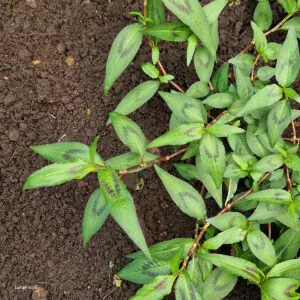
How to grow Laksa Leaves (aka Vietnamese Mint, Vietnamese Coriander)?
Equipment
- 1 pair scissors or secateurs
- 9cm/3.5" plant pots
- saucer for the pots
- plant label if necessary so you don't forget what you're growing!
Ingredients
- 3-4 stems sprigs laksa leaves or cut equivalent number from a plant
- compost for young plants or multipurpose compost
- vermiculite
- water
Instructions
- Pick the bottom leaves off, leaving about 2 nodes clear.If getting cutting from a plant, be sure to cut at an angle and above a node.3-4 stems sprigs laksa leaves
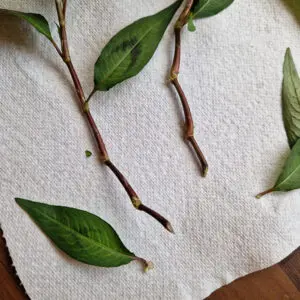
- Fill a small glass (opaque if possible) with water and submerge the bottom part of the stems in water. Ensure that 2 nodes are in the water. Top up as necessary.Place somewhere bright but not in direct sunlight.water
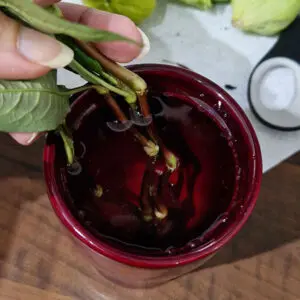
- After a week or so (this might depend on the temperature), you'll see roots growing.For the first day or so, the leaves may look droopy or unhappy, don't worry, they'll perk up.
- Get your small plant pot (9cm/3.5in) and fill it with a compost for young plants, mixed with a little vermiculite.Photo soon!compost for young plants, vermiculite
- Push your finger into the compost creating a deep but narrow hole. Push a single stem into the whole, being careful not to break the roots. Ensure that the roots are comfortable at the bottom. Fill it up, press down firmly and water well.Repeat with the other stems. Keep it somewhere warm and bright while it’s still establishing itself, before planting out, if that's what you want to do.Photo soon!
- As the plant grows, you'll need to re pot it into a bigger plant pot.Feed it weekly as described in the article above, but don't over water, especially in winter.
Video
Enjoyed this recipe? Add us to your Google Search Preferred Sources:
Hi, I’m in UK and would love to grow some if you could send me any cuttings.
Hi Josephine, I don’t have any viable ones at the moment, but they are just beginning to come back up in the garden (if we don’t get a cold spell).
However, if you shop on Ebay, take a look at these small companies: https://www.ebay.co.uk/sch/i.html?_nkw=vietnamese+coriander&_sacat=0&_from=R40&_trksid=p4624852.m570.l1313
Thank you so much for your reply and advice! I felt guilty for delaying the potting (I think it was about 2 weeks) and really thought that caused the poor plant to have brown leaf tips! 🙄 Yes I will feed it plant food to nurse it back to health! 😊 I don’t have to continue with it once the leaves look normal right?
I was watering it once every 3 days or so and each time before I watered it, I would feel the compost and it would still feel moist! But I watered it anyway. Is that ok? It’s on a window sill. I’m in the UK as well. 😉
It’s my pleasure, Gwen.
This time of year, you may need to reduce the amount of water, but twice a week sounds about right.
With the feeding – I would continue to feed it right throughout winter, once a week should suffice. This is because the plant continues to grow, although a little slowly.
If you have no luck whatsoever with reviving it, you’ll be pleased to know that there are so many small ebay sellers offering them as Vietnamese Coriander.
I have three plants – bought as Vietnamese Coriander. The first grew amazingly as did the next two – bought in case the first didnt survive! I LOVE the aroma but as with all my other herbs, I’ve not done anything with them yet apart from ‘scratch and sniff’. Thats why I want to say thank you and let people know I got mine – and loads of other herbs – from Urban Herbs. Their site is now closed until the next growing season but they are an independent nursery in the West Midlands and well worth checking out. ALL the herbs bought have at least trebled in size within 3 weeks. The other good place is Victoriana Nurseries
That’s awesome, thanks for letting everyone know.
Thank you, you’re Godsend!
My pleasure, Van.
Hi Azlin,
So glad to have found your page! My aunty gave me 2 stem cuttings a couple of months ago. The leave tips (many of them) are brown now and I don’t know what the problem is. i thought it was because I took too long to pot them after the roots emerged. Or I thought it could be that I was overwatering or underwatering. May I know how often you water your plant if indoors?
I planted them in compost. Based on your article, it would seem that the leave tips are brown cos they have no plant food? Please advise. Thank you in advance!
Hi Gwen, that’s very frustrating, sisn’t it? I don’t think it’s because you took too long to pot them up. I have them growing in a vase of water for ages on my kitchen windowsill and they are quite happy for weeks.
I went through this same thing many years ago until I figured out that it’s not the cold nor lack of light, but the food.
Get an all purpose plant food, or even tomato food and feed your plant twice a week until its leaves are looking healthy again.
In the summer, I water the indoor plant every day still because mine lives in the conservatory which gets hot and receives a lot of light.
But if it’s on a windowsill without too much direct sunlight, every other day will work. Take a look the top of the compost, if it’s looking dry and coming away from the edge of the pot, give it some water.
I have a YouTube video of this, just realised I didn’t get around to adding it here.
This is the link for it, the video has timed chapters, so you can skip to the part on “How to maintain your plant” which is at around 4:55
Laksa Leaves YouTube video
Get back to me if you have anymore questions, but do let me know how you get on.
Thank you Lin. I’m going to try this from Ebay when I come back to the UK for xmas. I love laksa, now I know why laksa in the West tastes nothing like what I’ve had in Malaysia!
Awesome, any problems, just ask!