

Enjoyed this recipe? Add us to your Google Search Preferred Sources:
Roti jala is a soft, lacy Malay net pancake popular in Singapore and Malaysia. Often described in English as Malaysian net pancakes or Malaysian net crepes, they’re made from a thin turmeric-tinted batter and usually served with curry. This easy roti jala recipe also includes a simple vegan variation, plus tips for making it with or without a traditional mould.
Table of contents
- What Is Roti Jala?
- Language Detour
- A Little Background
- The Recipe
- Roti Jala without a Special Dispenser
- Pandan “Brush” for Roti Jala
- Vegan Roti Jala
- Gluten Free Roti Jala
- Why do we Rest the Batter?
- How much Liquid?
- Best Pan for Roti Jala
- Troubleshooting Roti Jala
- How to Serve
- How to Store Leftovers
- Variations
- Roti Jala FAQs
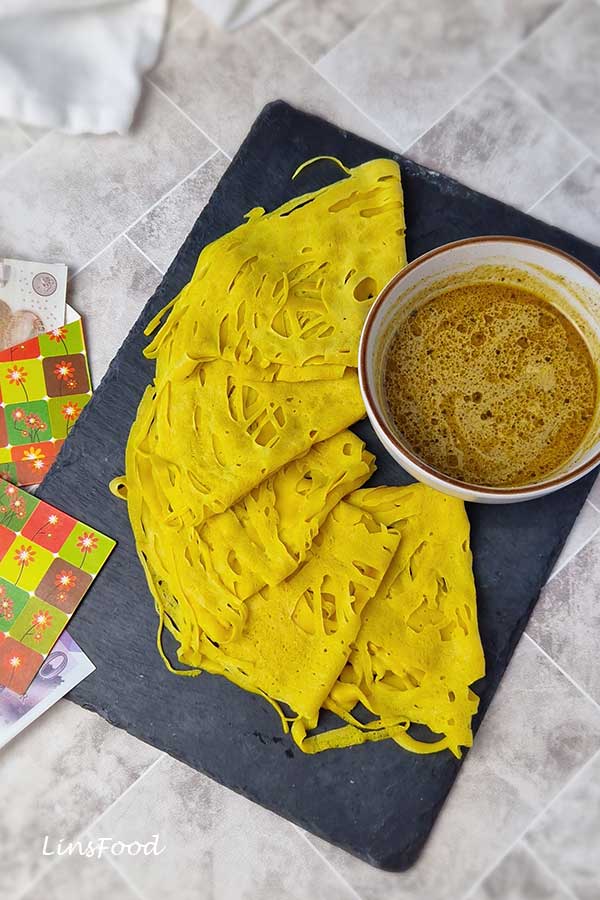
What Is Roti Jala?
Roti jala is a soft, lacy Malay pancake made by drizzling a thin batter onto a hot pan until it forms that signature net-like pattern. It looks terribly clever, but it’s actually quite straightforward once you get the hang of it.
The word jala means net, and once the batter hits the pan, it turns itself into delicate, webby pancakes that do a brilliant job of scooping, dipping and making a good curry even better. You’ll sometimes see it described as net pancakes, lace pancakes or net crepes, which all make sense visually, even if none of them sounds half as nice as roti jala.
It’s a Malay dish, not “Malaysian” in the national sense, and is also found in Singapore and parts of Sumatra. You may also hear it called roti kirai, and in some places roti renjis. Different names, same delicious idea: thin batter, quick wrist, lovely, rustic lacy finish, and something gloriously saucy on the side.
This easy roti jala recipe shows you how to make roti jala at home, even if you don’t have a traditional mould.
Language Detour
In Malay:
- Roti = generic name for bread of any kind
- Jala = net
- Renjis = splash (with water)
A Little Background
These lacy pancakes have been around a long time and have earned their rightful place as one of our much loved dishes. Like many families in Singapore and Malaysia, we love cooking roti jala for special occasions like Eid (Hari Raya in Malay).
Part of roti jala’s appeal is that it feels special without being difficult. It has that slightly show-off look to it, all golden and lacy and elegant on the plate, but the ingredient list is reassuringly simple. Flour, eggs, coconut milk, turmeric, water. Nothing dramatic. Just a batter and a bit of wrist action.
Despite its simplicity, it’s also one of those foods that feels right at celebrations, as mentioned above. It regularly makes an appearance at Eid, Malay weddings and celebrations.
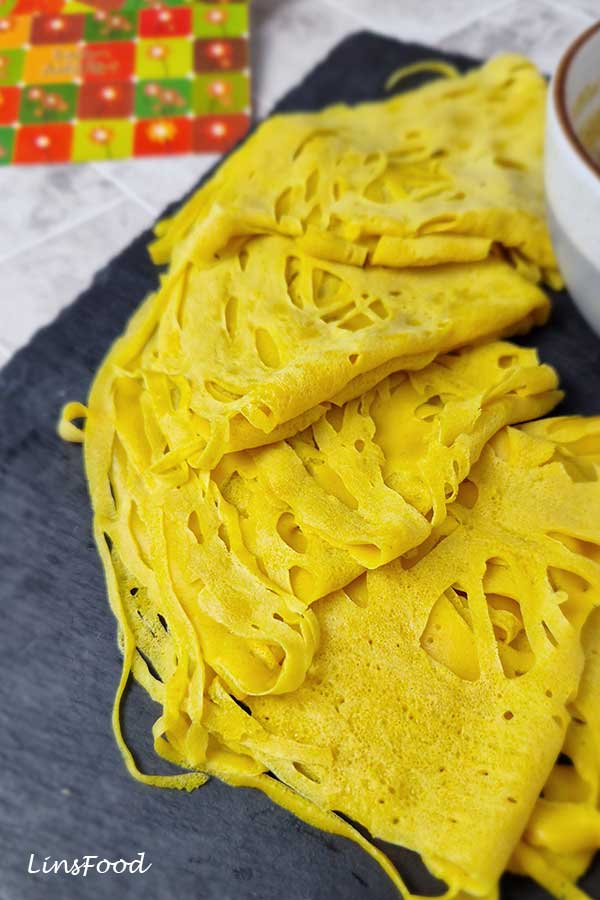
The Recipe
If you’re wondering how to make roti jala, the trick is not fancy equipment but batter consistency, gentle heat and a bit of patience.
This recipe here is for home cooks who want roti jala that’s soft, pliable and actually worth rolling or folding, not the sort that cracks the moment you so much as breathe near it.
Roti jala is cooked on one side only, just until set, so it stays soft enough to fold or roll.
The secrets are not remotely glamorous, but they do matter: strain the batter, let it rest, keep the heat sensible, and don’t overcook it.
This is what we’ll be doing:
- Make the batter
- Rest (20 minutes)
- Strain
- Cook (about 45 seconds each roti)
Roti Jala without a Special Dispenser
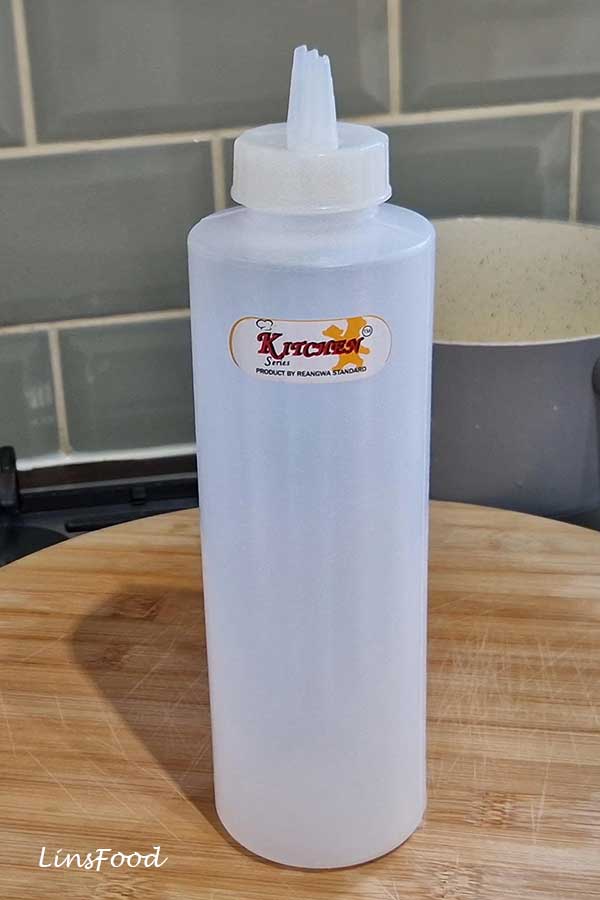
You can absolutely make roti jala without a mould or special dispenser. A regular squeeze bottle does the job perfectly well, which is excellent news for the rest of us.
You can see from the video that I’m using one with three spouts. It’s a modern roti jala mould, courtesy of my sister-in-law in Singapore.
Roti Jala no-mould methods from my grandma:
- Dip super clean fingers in the batter and drip it over the pan in a circular motion. It may take you a few dips. This was the traditional method of making it – hence the name roti renjis – dip your fingers and “splash” all around the pan.
- Knock 2-3 holes in a clean, empty food can and use that as your mould.
Pandan “Brush” for Roti Jala
A much nicer, more traditional way to oil the pan is with a pandan leaf brush. Just tie 1 or two pandan leaves together (see video) and use them to lightly brush the surface before each roti jala.
It gives the pan just enough oil, adds a subtle fragrant note to the pancakes, and saves you from the slightly ridiculous business of oiling the pan only to wipe half of it off again with kitchen paper.
I don’t remember a single time when we made roti jala without this pandan brush, even here in the UK.
Vegan Roti Jala
If you want a vegan roti jala version, it’s wonderfully low-effort. You simply leave out the eggs and add a small pinch of baking powder instead. That’s it. No strange substitutes, no flax egg nonsense, no aquafaba, no sweet potatoes that will just alter the taste, and no ingredient that requires a spiritual journey to a health food shop.
The texture is slightly different from the classic version, but you still get soft, lacy roti jala that fold and roll beautifully, as long as you strain the batter, let it rest, and don’t cook them into crisps.
Gluten Free Roti Jala
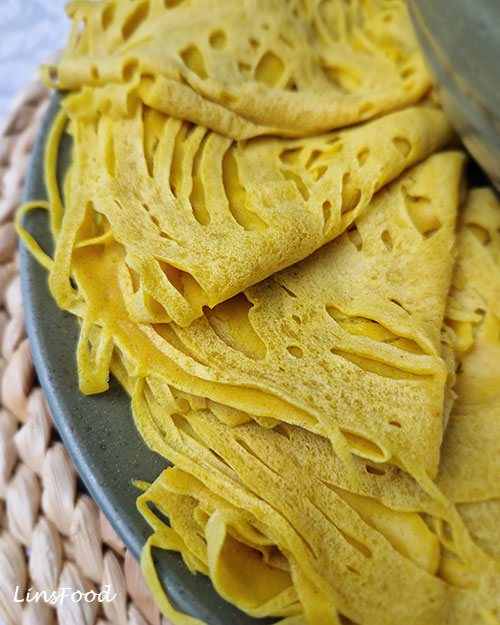
Yes, you can make gluten free roti jala, but this is one of those times when the flour really matters. Because the batter needs to be thin enough to drizzle and delicate enough to form those lacy lines without turning brittle, I would not use a single gluten free flour on its own.
Rice flour alone can be a bit fragile, coconut flour is far too thirsty, and neither will behave quite like plain flour here. A good gluten free plain flour blend or 1-to-1 baking blend is the better choice, because it gives you a more balanced mix of starches and structure.
If you’re in the UK, the easiest recommendation is a plain gluten free blend such as Freee by Doves Farm. Their own crêpe and pancake recipes use their gluten free plain flour successfully, which makes it a sensible starting point for something as thin and delicate as roti jala.
If you’re using a 1-to-1 baking blend, that works too, especially if it already includes xanthan gum. Manufacturers design these blends to replace wheat flour directly, and they usually work well in pancakes and similar batters.
The only thing to bear in mind is that gluten free batter often needs a little tweaking. You may need slightly more liquid to get that same smooth, pourable consistency, and if your flour blend does not already contain a binder, a tiny pinch of xanthan gum can help the roti jala stay flexible rather than crumbly.
Give the batter a rest, stir it again before cooking, and expect to adjust by eye rather than following the liquid amount like gospel. That, frankly, is true of ordinary roti jala too.
Why do we Rest the Batter?
Resting the roti jala batter gives the flour time to fully absorb the liquid, which helps the roti jala cook up smoother, softer and more pliable. It also allows the gluten to relax after mixing, so the batter flows more evenly and the finished pancakes are less likely to turn chewy or rubbery.
On top of that, any little air bubbles get a chance to settle, which means the batter runs more smoothly through the mould or bottle instead of spluttering. In practical terms, a rested batter is simply easier to work with and gives you neater, more flexible roti jala that fold and roll far more nicely.
Let it rest, then strain it.
How much Liquid?
This is probably the part that gives you the most “trouble”. I’ve given you 350 ml of coconut milk, which is just shy of 1 large can. On top of that, you’ve also got 400 ml water (just shy of 2 cups).
The “problem” is the coconut milk. For those of us who rely on canned coconut milk, the consistency of our roti jala batter is very much affected by the coconut milk we use.
I chop and change between 3 brands, depending on what’s on offer. The one thing they all share is that they have a fairly high coconut content. However, one is so much thicker than the other 2. So when I’m making roti jala with it, I use all the water, sometimes even 2 whole cups.
But when I’m using the thinner ones, I don’t need as much water. So this is what you have to bear in mind. Don’t use all the water, go by the consistency of your batter.
Best Pan for Roti Jala
The best pan for roti jala is a good non-stick frying pan or crêpe pan with a flat base and fairly low sides. You want something that heats evenly, lets the batter set gently, and makes it easy to lift the roti jala out without tearing.
If you make this sort of thing all the time, a proper crêpe pan or well-seasoned carbon steel pan is lovely, but for most home cooks, a reliable non-stick pan is the easiest and most practical choice.
Keep the heat on the lower side rather than blazing hot, as roti jala should cook gently and stay soft enough to fold, not brown aggressively and turn brittle.
Troubleshooting Roti Jala
If the batter is too thick, it will be difficult to squeeze through the holes and your pattern will look clumsy rather than lacy. If it is too thin, the lines can break up into dots or merge oddly. The easiest fix is to test one piece, then adjust with a splash more water or a spoonful of flour before continuing.
If your roti jala keeps breaking when you lift it, it is usually undercooked or the pattern has been made too thin. Keep the heat gentle, let it set fully, but do not leave it long enough to brown heavily. A great visual cue here is to look out for the edges to just begin to lift ever so slightly. This means that the roti is solid enough to lift but not too crisp that it will break and lose that signature softness.
If it tastes rubbery, the batter may need resting or the pancake may be slightly undercooked. That short rest is doing more work than people think.
If it sticks, wipe the pan with a little more oil before the next one. If it cracks when you fold it, it usually means you’ve cooked it too long and let it dry out. And remember, use a non-stick pan.
And yes, the first one or two may look a bit wonky. That’s not a disaster. That’s simply the pan, the batter and your wrist getting acquainted.
How to Serve
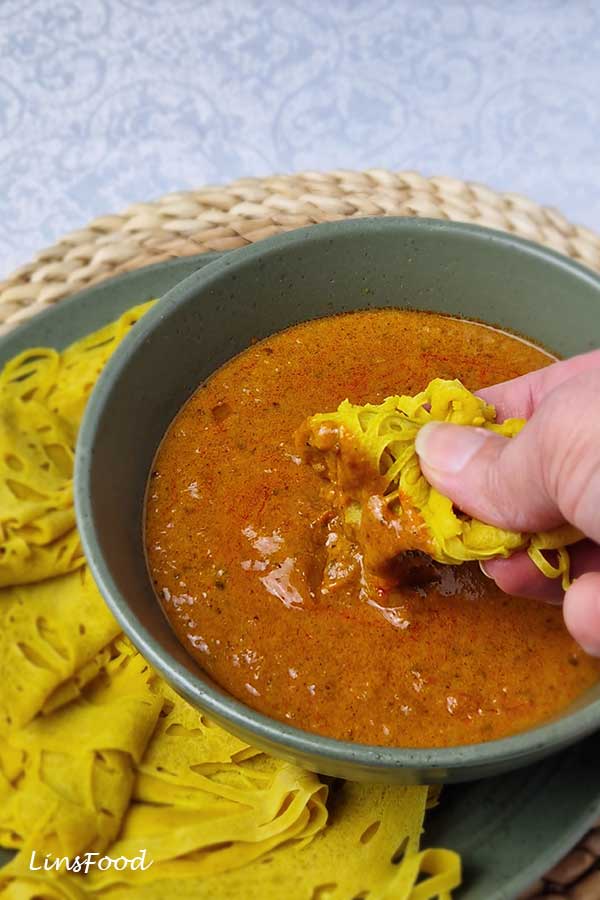
We most often serve roti jala with curry, and honestly, that’s exactly where it shines.
This chicken curry (kari ayam in Malay) makes a classic pairing, as does beef rendang or chicken rendang. In fact, for Eid, rendang is the perfect partner as it’s a must for most Malay households celebrating Hari Raya.
Truth be told, though, roti jala is happy with just about any curry.
How to Store Leftovers
Let the roti jala cool completely before storing so trapped steam doesn’t make them damp. Stack them in an airtight container, with baking paper between layers if you like, and refrigerate for up to 3 days.
For freezing, lay them in a single layer first until firm, then transfer to a freezer bag or container so they do not stick together. To reheat, sprinkle lightly with water and microwave briefly, or warm them gently in a pan over low heat. The goal is softness, not crisping.
Variations
For a richer roti jala, you can use a little more coconut milk, though you may need to rebalance with water so the batter still flows properly. If you want a slightly fluffier result, some cooks add an extra yolk.
If you want to play with natural colour variations, swap some of the liquid for pandan, beetroot juice or butterfly pea flower water. That said, the turmeric-yellow version is still the classic look and the one most people expect.
You can also change the shape after cooking. Some cooks roll them into neat cylinders, while others fold them into triangles or quarters. See video.
Roti Jala FAQs
Yes. Roti jala is often described in English as Malaysian net crepes, Malaysian net pancakes, lace pancakes or net crepes because of its delicate web-like pattern.
The word jala means net, which refers to the lace-like pattern made when the batter is drizzled onto the pan.
Yes, roti kirai is one of the alternate names used for roti jala. In some places, you may also hear it called roti renjis.
Yes, you can. A squeeze bottle works very well and is probably the easiest option for most home cooks. The important thing is that the batter can flow out in thin streams to create that signature net-like pattern.
Yes, definitely. Resting the batter for about 20 minutes helps the flour hydrate properly and usually gives you softer, more pliable roti jala.
The batter is usually too thick, the holes in your dispenser are too small, or you are pouring too slowly. The batter should be thin enough to flow easily and form light, overlapping lines on the pan. But don’t worry too much about getting perfect spirals and lines – it’s meant to be a rustic dish.
Roti jala usually breaks because it is undercooked, too thinly drizzled, or overcooked and dried out. It should be cooked just until set and still soft enough to fold without cracking.
No, roti jala is usually cooked on one side only. Once the surface is set and the pancake lifts easily, it is ready to come out of the pan.
No, it’s the same thing, with only small household or regional differences.
Very often, yes. It’s a popular choice for festive meals and celebrations.
Yes. Once cooled, stack the pieces with baking paper between them if needed, then freeze in an airtight container or freezer bag. Reheat gently so they stay soft.
Roti jala is most commonly served with curry, such as chicken curry, beef curry, dhal or rendang. Anything with plenty of sauce is a very good match.
A good gluten free plain flour blend or 1-to-1 baking blend is the best choice for gluten free roti jala. It gives you a better balance of structure and flexibility than using a single flour on its own, which is important for getting that thin, lacy texture.
And there you. All you ever needed to know about roti jala, and maybe some you didn’t! If you make it, let me know how it went. And tag me on Instagram with a picture @azlinbloor.
Roti Jala (Lacy Malay Net Pancakes)
Ingredients
- 260 g plain flour
- 1 tsp ground turmeric
- ½ tsp fine salt
- 2 large eggs
- 300 ml coconut milk
- 2 tsp neutral oil plus more for lightly greasing the pan
- 400 ml water
Instructions
- In a large bowl, whisk together the flour, turmeric, salt and sugar.260 g plain flour, 1 tsp ground turmeric, ½ tsp fine salt
- Add the eggs, oil and coconut milk, then whisk until smooth.2 large eggs, 300 ml coconut milk, 2 tsp neutral oil
- Gradually whisk in the water. You want a thin, pourable batter, roughly like single cream. If it still feels too thick to flow easily, add more water a little at a time.Don't add all of it at once, as you don't want a batter that's too runny.400 ml water
- Rest the batter for 20 minutes.
- Strain the batter through a sieve into a jug or bowl. This makes a real difference, because even a few stubborn lumps will clog your bottle or cup and ruin the lace effect.
- Pour the batter into your roti jala cup or squeeze bottle.
- Heat a non-stick pan over medium-low heat and lightly oil it with a pastry brush. This should ensure that your pan is only lightly greased, not swimming in oil. So there shouldn't be any need to wipe excess with a kitchen paper as you read on all other food sites.
- Drizzle the batter onto the pan in overlapping circles or a loose criss-cross pattern, covering most of the surface but not piling batter too heavily in one spot.Don't worry too much about getting perfect waves or circles. It's not mean to be pretty, we just want crisscrossed lines, as we'll be rolling or folding it all up.
- Cook for about 45 to 60 seconds, or until the surface is set and the pancake lifts easily. Do not flip. Roti jala is usually cooked on one side only, and overcooking makes it brittle.A great visual cue here is to look out for the edges to just begin to lift ever so slightly. This means that the roti is solid enough to lift but not too crisp that it will break and lose that signature softness.
- Lift it out gently with a spatula or your fingers once cool enough to handle.Fold in the sides and roll it up, or fold into quarters or triangles if that is your preferred style.I fold it in the pan itself, as you can see in the video. If rolling, it's best to transfer to a board to do it.
- Repeat with the remaining batter, giving the pan the lightest swipe of oil as needed.A good roti jala should be soft, thin, pliable and properly lacy. If the first one looks tragic, welcome to the club. The second and third are usually where your hand finds its rhythm.
Nutrition
Enjoyed this recipe? Add us to your Google Search Preferred Sources: