

Enjoyed this recipe? Add us to your Google Search Preferred Sources:
Pecah minyak is something I’ve mentioned a lot on this site; here’s the promised comprehensive blog post about it! If you’ve ever followed a recipe that says “fry the paste until the oil separates,” you’ve met pecah minyak, aka oil splitting. Or oil separation. Keep reading!
Estimated reading time: 8 minutes
Table of contents
- What is Pecah Minyak?
- The Importance of Pecah Minyak
- What’s Happening during Oil Separation
- How to spot the Oil Splitting stage
- Fresh Chillies vs Dried Chillies
- How long to fry Spice Paste until Pecah Minyak?
- Why your Paste won’t Split
- How to Avoid Burning
- Can a Paste be Cooked Enough without a Dramatic Oil Split?
- Pecah Minyak FAQs

What is Pecah Minyak?
- Pecah = break
- Minyak = oil
In much of Asian cooking, many of our dishes call for a spice paste to be fried in oil before we proceed with the rest of the recipe. This can be a simple mix of onion and garlic, or we can have chillies, lemongrass, galangal and spices added. It all depends on the recipe.
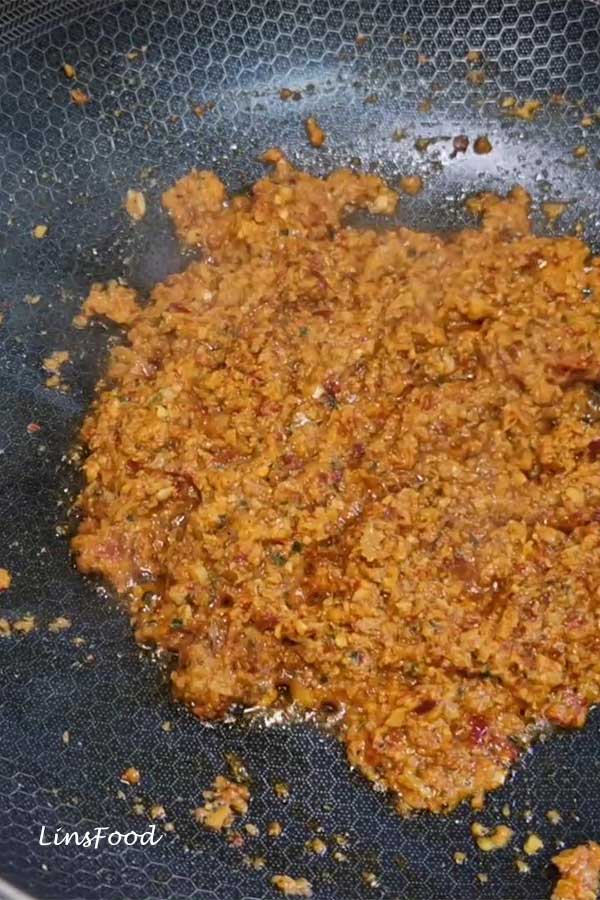
Pecah Minyak (oil splitting/oil separation) is that step when the oil you’re frying in becomes visibly distinct from the paste. It’s the moment when a wet, matte paste turns glossy, darker, and you begin to see oil pooling around it.
This cue shows up across cuisines because the underlying method is the same: you’re cooking off moisture, frying aromatics, and blooming spices in fat until the paste becomes a concentrated flavour base.
It doesn’t matter whether the paste uses fresh chillies or dried chillies. Both can reach the oil separating stage. What changes is how quickly it happens and how dramatic it looks.
Early on, your paste is full of water from onions/shallots, garlic, ginger, chillies and so on. While water is still abundant, the paste behaves like it’s steaming and simmering. The oil is present, but it’s dispersed through a wet, thick mixture.
As the rempah (spice paste in Malay) cooks, water evaporates. The paste reduces, thickens, and the temperature in the pan rises. Once there’s not enough moisture left to keep everything uniformly mixed, the oil becomes visible again. You’ll see it as a sheen, little pools around the edges, or patches on top and in between.
That visible oil is why recipes say “until the oil separates” or as I say “until the pecah minyak stage”.
The Importance of Pecah Minyak
Spice pastes usually taste harsh and raw. The separation of the oil from the spice paste is a sign that you’ve cooked the paste long enough to build depth.
What improves at this stage:
- raw onion/garlic/ginger sharpness mellows
- spices smell rounder and toastier
- sweetness develops from cooked aromatics
- the paste thickens into a proper base that won’t taste like blended ingredients
- fat-soluble flavour compounds move into the oil, helping aroma spread through the whole dish
If you’re wondering why your curry, stew, or sauce tastes like “raw paste,” this stage is often the missing piece.
What’s Happening during Oil Separation
Oil separation is the result of four overlapping changes:
Moisture evaporation
Fresh aromatics contain a lot of water. As that water turns to steam, the paste stays relatively cool and cooks more gently.
Reduction and concentration
As water leaves, the paste becomes denser. It stops being a wet mash and starts frying properly.
Spice blooming in fat
Many spice aromas dissolve and carry best in oil. Frying the paste helps those flavours spread and linger.
Oil becomes visible
With less water and a thicker paste, the oil can no longer stay evenly dispersed. It releases and you see it.
How to spot the Oil Splitting stage
To know if you’ve reached the pecah minyak stage, use oil as one clue, not the only clue. You want a combination of visual, aroma, sound, and texture changes.
Visual cues
- paste turns glossy rather than matte
- colour deepens (often redder or browner, depending on ingredients)
- oil pools at the edges or appears in small patches on top and in between
- paste looks tighter and more cohesive, not watery
Aroma cues
- raw, sharp smell fades
- spices smell warmer and more “fried”
- the scent becomes savoury and rounded rather than harsh
Sound cues
- early stage: loud steaming/sputtering
- later stage: steadier sizzling as water reduces
- near splitting: a more “dry fry” sizzle, less wet crackle
Texture cues
- paste thickens and drags slightly in the pan
- it moves as a mass rather than sloshing
- it looks glossy when stirred
Fresh Chillies vs Dried Chillies
The concept stays the same: cook off moisture, bloom spices, concentrate flavour, then oil becomes visible. We do this when cooking our sambal dishes like sambal tumis and prawn sambal bostador.
What can change:
- fresh chilli pastes often take longer because they bring more water
- soaked dried chilli pastes can darken faster and show more dramatic red oil
- dried chillies tint oil strongly, so separation can look more intense even when the paste isn’t fully cooked
This is why aroma and colour change are essential in knowing whether you’ve reached the pecah minyak stage. Oil appearance alone isn’t enough.

How long to fry Spice Paste until Pecah Minyak?
There isn’t a universal time, because it depends on the amount of moisture in your spice paste, the width of your pan and also, how much oil you’re using.
It can take anything from 5 minutes for a small amount of paste without added water, to 25 minutes for a large amount of paste.
A narrow pot with a big amount of paste traps steam and slows evaporation, so it takes longer and cooks less evenly. A wide sauté pan helps you reach the oil splitting stage more reliably.
And that’s why woks are great for whatever you’re cooking!
Why your Paste won’t Split
If you’re stuck in the “wet forever” stage, it’s usually one of these:
- Heat is too low
You’re simmering more than frying. Increase heat slightly. - Pan is too small for the amount of paste you have
Steam builds up and slows evaporation. Use a wider pan. - Too much paste at once
A thick layer holds moisture. Cook in batches if needed, or use a wider pan/wok. - Not enough oil
The paste can’t fry evenly and may catch once it thickens. Add a bit more oil and keep stirring.
How to Avoid Burning
Pecah minyak can make people nervous because it often happens right before burning does. The fix is simple: control heat and movement.
What helps:
- lower heat slightly as the paste thickens
- stir more often and scrape the base
- add a touch more oil if it’s catching
- add the next ingredients soon after the paste smells “done” and you see oil at the edges
If you smell bitterness or acrid smoke, that’s scorching. At that point, adding liquid may save the dish, but the flavour can stay harsh if the paste has genuinely burnt.
Start again?
The odd burnt bit because you took your eye off the ball is fine, just stir it into the paste. Happens to me from time to time too! Perfection is overrated.
Can a Paste be Cooked Enough without a Dramatic Oil Split?
Yes.
Some pastes won’t show dramatic separation because:
- the paste is more emulsified
- you’re using less oil so your paste was simmering instead of frying
- the cooking method is intentionally gentler
- ingredients are naturally smoother or finer
If you’ve got a deeper colour, a sweeter/toastier aroma, and the paste has thickened and turned glossy, you can be in the right place even without big pools of oil.
But if a recipe calls for pecah minyak, it’s not a suggestion. Do it.
Should you remove the separated oil? Short answer? No.
Pecah Minyak FAQs
Cook the spice paste until moisture evaporates, it thickens and darkens, and oil becomes visibly separate around the paste. It usually signals the paste is cooked out and flavour has developed.
You likely stopped too early. Look for the aroma shift (less sharp, more toasty), a darker colour, and a glossy paste. Oil separation can help confirm you’re there.
Use medium heat at first, stir frequently, and lower the heat as the paste thickens. Once the paste reaches the cooked stage, add the next ingredients promptly so it doesn’t keep frying dry.
Common reasons are low heat, a small pan (steam trap), too much paste at once, or not enough oil. A wider pan and a little more heat usually fix it.
No you don’t. You need enough but it doesn’t have to be a copious amount. The more your paste, the more oil you need. For a recipe that feed 4, 2 -3 Tbsp of oil should be enough to fry your rempah to hot the pecah minyak stage.
And there you go. Now when I say pecah minyak on this site, you know exactly what it means.
Any questions, just drop me a line. You’ll also always find me on Instagram as @azlinbloor.
Lin xx
What is Pecah Minyak and how to get it
Ingredients
As an example, refer to individual recipes
- onion
- garlic
- ginger
Instructions
Step 1: start with enough oil
- You don’t need a swimming pool, but you do need enough oil to fry rather than steam. Too little oil often leads to a wet simmer at first, then scorching once the paste dries.
Step 2: medium heat first, then adjust
- Begin on medium to evaporate moisture without burning aromatics. As the paste thickens, you can nudge heat slightly higher for gentle browning, then lower it again once it starts catching quickly.
Step 3: stir like you mean it
- Scrape the base, keep it moving, and don’t let it sit in one spot once it thickens. Near oil separation, burning happens faster because there’s less water buffering the heat.
Step 4: cook until aroma shifts and oil appears
- You’re looking for the combination: deeper colour, mellowed raw smell, glossy paste, and visible oil.
Step 5: move on promptly
- Once the paste is cooked out, add your next ingredients (meat, vegetables, tomatoes, stock, coconut milk) to stop the paste frying too aggressively and to lift any browned bits from the pan.
Video
Enjoyed this recipe? Add us to your Google Search Preferred Sources:
Thank you so much!
My pleasure.