

Pandan, or daun pandan, is one of the great quiet workers of Singaporean and Malaysian cooking. It perfumes rice, coconut milk, kuih, kaya and drinks with that unmistakable green, grassy, warm-rice fragrance. Tiny leaf. Massive kitchen presence.
Estimated reading time: 12 minutes
Table of contents
- What is Pandan?
- What Makes Pandan So Important in Singapore and Malaysian Cooking?
- Using the Leaves
- How to Use Pandan Leaves
- Pandan Leaves, Dried Pandan Leaves and Pandan Paste (and Extract)
- Where to Buy Pandan Leaves
- How to Store Pandan Leaves
- Variations and Substitutions
- Singaporean and Malaysian Recipes that Use Pandan
- Pandan FAQs
- Final Word
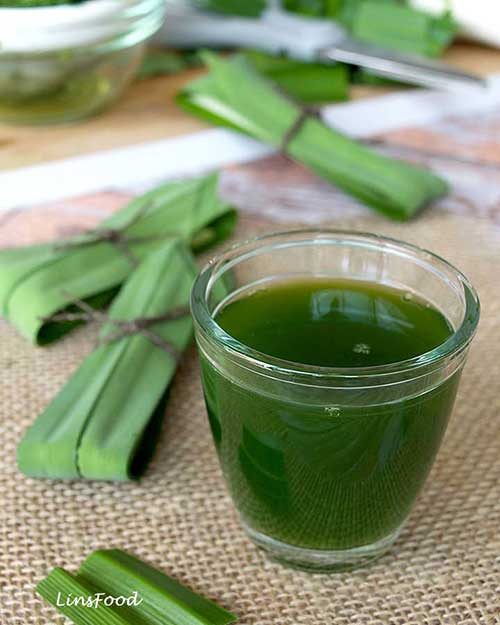
What is Pandan?
Pandan is a long, narrow, tropical leaf used across Southeast Asia as a natural flavouring and colouring ingredient. In Singapore and Malaysia, we usually call it daun pandan, which simply means pandan leaf in Malay.
It’s one of those ingredients that’s so familiar in the region, it can almost disappear into the background. Pandan leaves sit in rice cookers. They’re tied into knots and dropped into coconut milk. They’re blended into juice for kuih, cakes and puddings. They turn up in kaya, nasi lemak, cendol, bubur pulut hitam, onde-onde and many other sweet and savoury favourites.
Basically, if coconut milk is nearby, pandan is probably lurking somewhere. As it should.
The flavour is hard to describe if you didn’t grow up with it. People sometimes call pandan the “vanilla of Southeast Asia”, but I’ve never found that quite right. Pandan is greener, warmer and more fragrant than vanilla. It has the scent of freshly cooked rice, soft grass, coconut desserts and every pasar malam stall that knew exactly what it was doing.
What Makes Pandan So Important in Singapore and Malaysian Cooking?
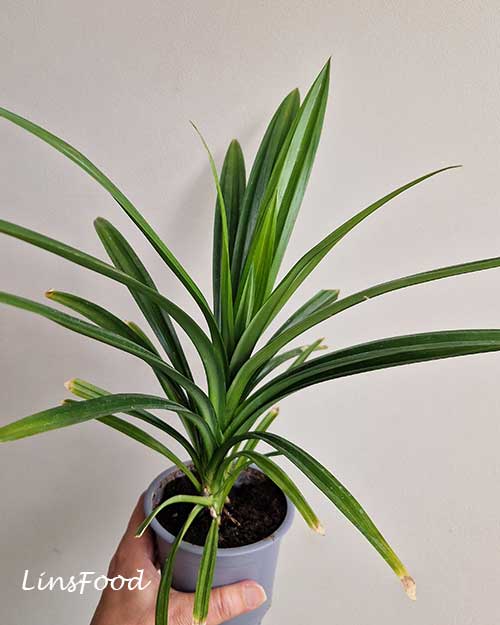
The culinary pandan we use is Pandanus amaryllifolius, a member of the pandanus family. The English name you’ll often see is fragrant screwpine, which sounds far more dramatic than the leaf itself. No, it isn’t pine. No, it doesn’t taste piney.
There are many plants in the pandanus family, but not all are used in the same way. The pandan leaves we use in Singaporean and Malaysian cooking are different from kewra, or pandanus flower water, used in parts of South Asian cooking. They’re related, but they’re not interchangeable. Kewra is floral and perfumed; daun pandan is leafy, grassy and warm.
Pandan grows easily in tropical climates. In Singapore and Malaysia, it’s the sort of plant you’ll find in gardens, pots, back corners and open fields sometimes growing like a weed. It has long blade-like leaves, a deep green colour and a scent that comes alive when bruised, pounded, heated or blended. Especially when it’s heated.
Fresh leaves don’t always smell strongly when you first pick them up. Then you cook with them and suddenly the whole kitchen knows what you’re up to.
Using the Leaves
Pandan juice is what you want when you need both flavour and colour. It’s made by blending pandan leaves with a little water, then straining the mixture to get a deep green, fragrant liquid.
Use it in kuih, cakes, puddings, drinks, jellies, kaya and coconut milk desserts where pandan is part of the actual flavour, not just a background scent.
This “recipe” is really a basic kitchen method: how to extract pandan juice. And then also how to use whole pandan leaves in cooking.
Whole pandan leaves are what you want when you need fragrance without turning everything green. Think rice, coconut milk, bubur, curries and syrups.
They each have their place in our kitchens.
How to Use Pandan Leaves
1. How to make Pandan Juice
This is the best method when you want pandan’s green colour as well as its flavour.
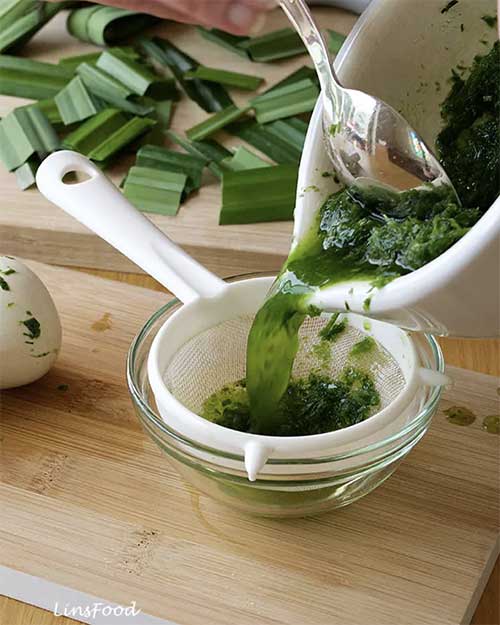
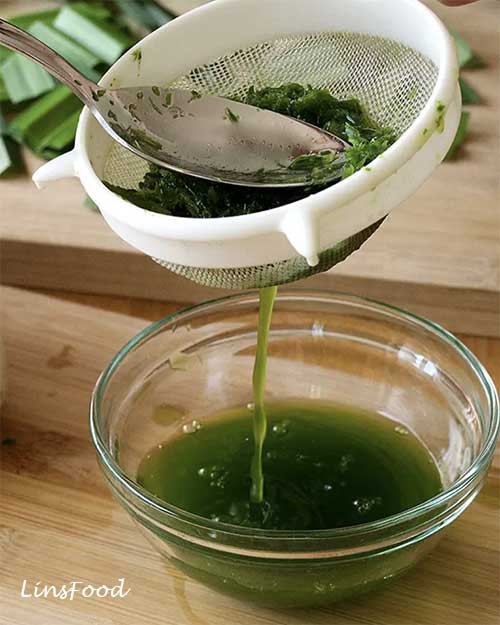
Cut the leaves into short lengths, blend them with a little water, then strain and squeeze the pulp. You’ll get a deep green juice that can be used in cakes, kuih, jellies, drinks, custards and puddings.
Use pandan juice in:
- pandan chiffon cake
- onde-onde
- kuih dadar
- kuih seri muka
- cendol
- agar-agar
- sago pudding
- coconut milk desserts
- pandan kaya
- pandan mahalabia
- drinks and syrups
If you leave fresh pandan juice to sit, it may separate. That’s normal. Stir it before using.
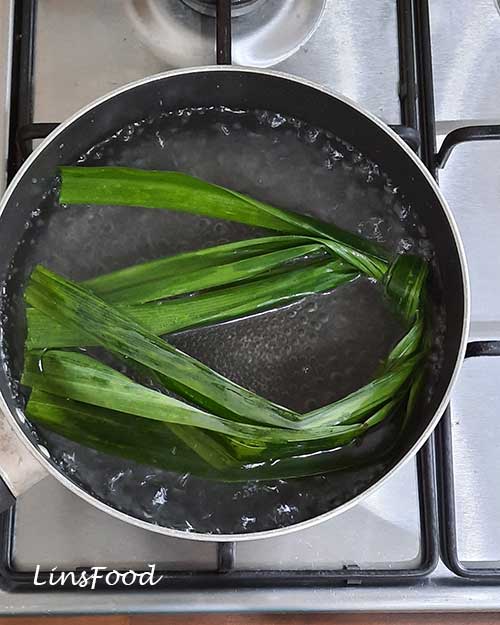
2. Tie the leaves into a knot
This is the classic everyday method. Take one or two pandan leaves, tie them into a knot and drop them into your pot.
The knot bruises the leaves slightly, helps release their aroma and makes them easier to fish out later.
Use knotted pandan leaves in:
- nasi lemak
- nasi minyak
- nasi tomato
- bubur pulut hitam
- bubur kacang hijau
- bubur lambuk
- coconut milk sauces
- palm sugar syrups
- sweet soups
- curries
Remove the leaves before serving. They’re there for aroma, not chewing.
3. Use pandan leaves to wrap food
Pandan leaves can also be used as wrappers, especially for small pieces of chicken or fish. The leaf protects the food a little and adds a beautiful fragrance as it cooks.
Thai pandan chicken is the famous example, but the idea works beyond that. Small marinated pieces, wrapped neatly and fried, grilled or baked, come out fragrant and rather lovely.
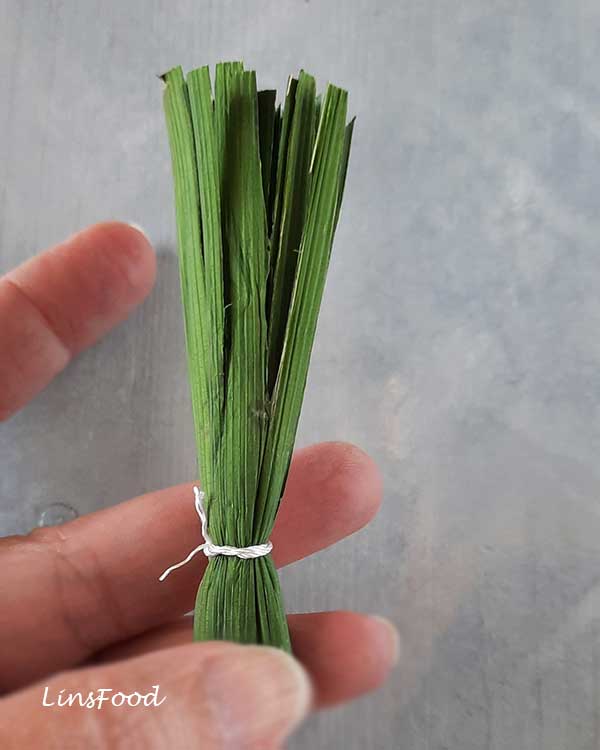
4. Make a little “Pandan Brush”
A pandan leaf brush is used much like a pastry brush, but with the added bonus of gentle fragrance. Dip the tied leaves into a little oil, then lightly grease your pan. We use it when making roti jala, pancakes and kuih dadar (aka kuih ketayap).
It helps spread the oil thinly and evenly, while the warm pan releases just a whisper of pandan. Practical, pretty and very old-school. I learnt it from my grandma, naturally.
Pandan Leaves, Dried Pandan Leaves and Pandan Paste (and Extract)
Fresh pandan leaves
Fresh leaves give the cleanest flavour and best colour. Use them as soon as possible, especially if you’re extracting juice.
Frozen pandan leaves
Frozen pandan leaves are very useful and often easier to find in the UK, Australia, Europe and North America. Use them straight from frozen or let them thaw for a few minutes before cutting.
They may look a bit darker and softer than fresh leaves, but the flavour is usually still good.
Dried pandan leaves
Dried pandan leaves are not my first choice. They can work for light infusions, but the flavour is much weaker and also just severy so slightly different. As many dried herbs can be. Use them only if fresh or frozen leaves are impossible to find.
Pandan paste or extract
Pandan paste is strong, convenient and usually very green. Sometimes alarmingly green. It can be useful in baking, but check the label because many commercial pastes contain colouring and artificial flavouring.
There’s nothing wrong with using it when you’re desperate, but if you’re making something where pandan is the main flavour, fresh or frozen leaves will give you a softer, more natural taste.
The same goes with pandan extract, always check what’s in the bottle.
Where to Buy Pandan Leaves
In the UK, you’ll usually find pandan leaves in Asian grocery shops, especially Chinese, Thai, Vietnamese, Filipino, Malaysian, Singaporean and Indonesian stores. Look in the freezer section; most shops sell them frozen in clear packets.
Some larger international supermarkets may carry them fresh, depending on where you live.
You can also buy pandan leaves online. Search for fresh pandan leaves, frozen pandan leaves or daun pandan.
You may even be able to grow pandan in a pot. In cooler climates, it’ll need warmth, light and protection from frost. Pandan is tropical. It doesn’t want to be standing outside in a British winter wondering what crime it committed.
I’ve been growing it for many, many years. It stays in its pot, goes out in the summer if the evenings aren’t too cool, and comes back in as soon as evening temperatures start to dip. That can be late summer or very early autumn.
How to Store Pandan Leaves
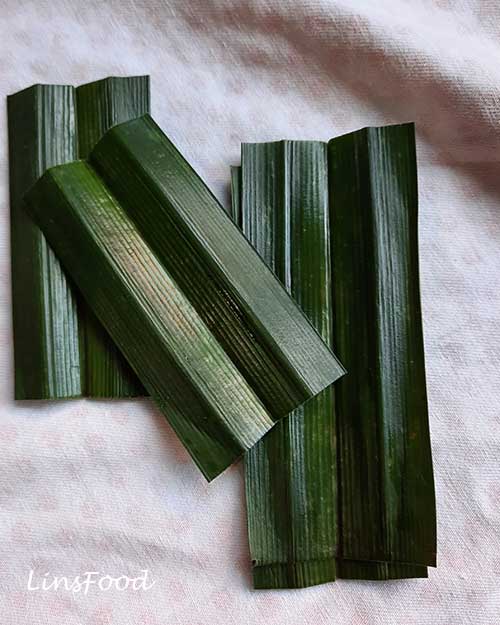
Fresh pandan leaves can be wrapped in kitchen paper, placed in a bag or container and kept in the fridge for about 2 weeks. But they are best usually in the first week.
For longer storage, freeze them. Wash and dry the leaves well, then freeze them whole or cut into shorter lengths. Frozen pandan leaves can be used directly in cooking, especially for rice, bubur and coconut milk desserts.
Pandan juice is best used fresh, but you can keep it in the fridge for 2-3 days. For longer storage, freeze it in ice cube trays. Once frozen, transfer the cubes to a freezer bag or container.
That way, when a recipe needs a little pandan, you don’t have to start the whole blend-strain-squeeze drama from scratch.
Variations and Substitutions
There’s no substitute for pandan. Annoying, but true.
Some people suggest vanilla as a substitute, which makes me wonder whether they’ve ever met fresh pandan in real life. Pandan smells greener and warmer, with that soft, steamy fragrance you get from freshly cooked jasmine rice. Vanilla doesn’t do any of that.
If a recipe only uses pandan as a background fragrance, you can leave it out if you must. The dish will still work, but it will lose a layer of aroma. But you do what you have to do, right?
If the recipe is pandan-forward – pandan chiffon cake, kuih dadar, onde-onde, pandan kaya, cendol – don’t substitute it. The pandan is not decorative. It’s the whole point. So try your best to get your hands on some leaves.
For colour, you can use a little green food colouring, but that only gives colour, not flavour. Pandan paste gives both colour and flavour, though the taste depends on the brand.
Singaporean and Malaysian Recipes that Use Pandan
Pandan turns up all over Singaporean and Malaysian cooking, especially where rice, coconut milk and palm sugar are involved.
Good places to start:
- Kaya, the coconut and pandan jam we spread on toast
- Nasi lemak, where pandan perfumes the coconut rice
- Bubur pulut hitam, black glutinous rice pudding with coconut milk
- Bubur kacang hijau, sweet mung bean porridge
- Pandan mahalabia with gula Melaka and coconut (this is my twist on a Middle Eastern classic)
- Onde-onde, filled with molten gula Melaka
- Kuih dadar, pandan crepes with coconut filling
- Seri muka or kuih salat, glutinous rice topped with pandan custard
- Cendol, with pandan jelly, coconut milk and gula Melaka syrup
Pandan isn’t loud. It has a fairly subtle aroma that’s only released when it’s heated.
Pandan FAQs
Pandan is often called fragrant screwpine in English. In Singapore and Malaysia, it’s more commonly called pandan or daun pandan.
Pandan tastes and smells grassy, warm, slightly nutty and rice-like, with a soft sweetness. Many people compare it to vanilla, but the flavour is greener and more aromatic, nothing like vanilla.
Yes, frozen pandan leaves work very well. They’re one of the best options if you live outside Southeast Asia and can’t find fresh leaves.
You can, but dried pandan leaves have a much weaker flavour. Fresh or frozen leaves are better for most Singaporean and Malaysian recipes.
No. Pandan juice is made by blending fresh or frozen pandan leaves with water and straining them. Pandan paste is usually a commercial product and may contain colouring, flavouring and other ingredients.
We use pandan leaves for flavour (and colour) and remove them before eating. They’re fibrous and not pleasant to chew.
For a small pot of rice, 1-2 leaves tied into a knot is usually enough. For a larger pot, use 2-3 leaves.
The colour depends on the freshness of the leaves, how much water you used and how finely the leaves were blended. Use less water for a stronger colour and flavour.
Yes. Freeze pandan juice in ice cube trays, then store the cubes in a freezer bag or container. It’s very handy for desserts and drinks.
Pandan is used in kaya, nasi lemak, onde-onde, cendol, kuih dadar, bubur pulut hitam, bubur kacang hijau, pandan chiffon cake and many coconut milk desserts.
See the article for the links.
Final Word
And there you go. Pandan may look like a simple green leaf, but in Singaporean and Malaysian cooking, it carries a whole world of fragrance. Rice becomes warmer. Coconut milk becomes rounder. Gula Melaka gets deeper. Kuih tastes exquisite.
It’s one of those ingredients that doesn’t need much fuss. Tie it, bruise it, blend it, squeeze it, simmer it. Then let it do what it does best.
Let me know if you’re a fan.
Lin xx
How to Extract Pandan Juice
Equipment
- sieve
Ingredients
- 12 pandan leaves fresh or frozen
- 125 ml water
Instructions
- Wash the pandan leaves and pat them dry.
- Cut the leaves into short lengths, about 3-5 cm.
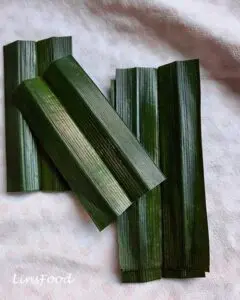
- Place the cut leaves in a blender or small food processor.
- Add just enough of the water to help the blades move.
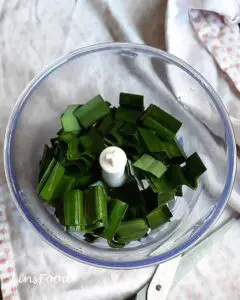
- Blend until the leaves are finely chopped and you have a wet, green pulp.
- Add the remaining water and blend briefly again.
- Pour the mixture through a fine sieve, muslin cloth or nut milk bag. Squeeze well to extract as much pandan juice as possible.
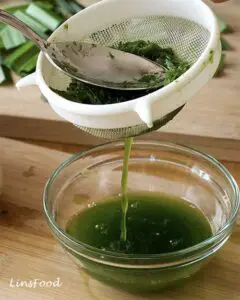
- Use immediately, refrigerate for 2-3 days, or freeze in ice cube trays.